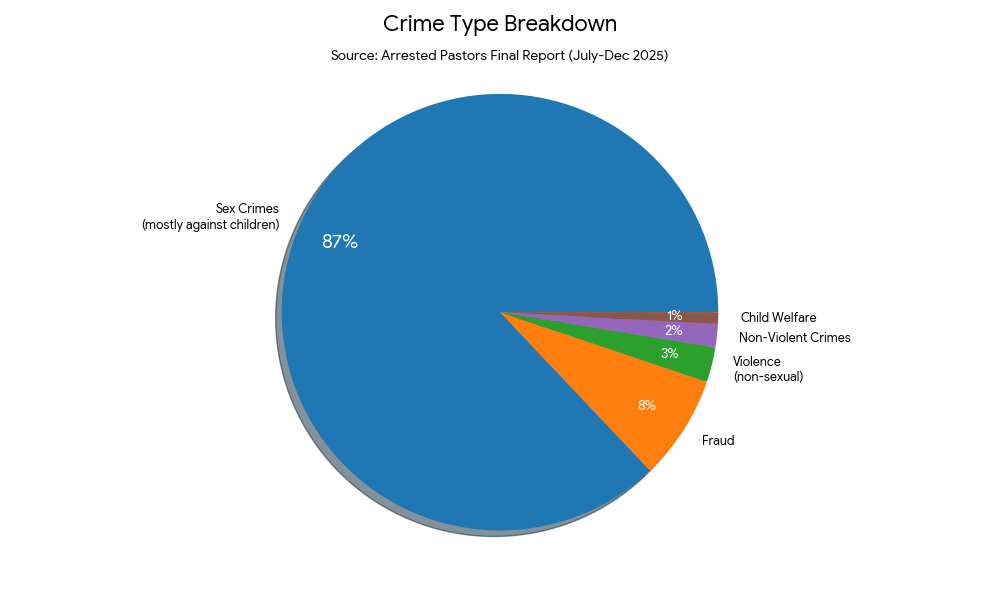
Of the crimes recorded from July 4, 2025, to Dec 31, 2025: 115 crimes were logged. Of the 115 crimes:
- 101 (87%) crimes were sex crimes (mostly against children)
- 9 (8%) arrests were related to fraud
- 3 (3%) were crimes of violence (non-sexual)
- 2 (2%) non violent crimes
- 1 (1%) child welfare
Scandals (non criminal ethical violations) amounted to:
12 events were tagged as Scandal.

The total of pastors & priests arrested or sentenced during this investigation was:
103 Protestant pastors, 12 Catholic priests and 2 that don’t fit with Protestant or Catholic.
Out of the arrests, the denomination break down is:
- 40 “Evangelical/non-denominational” pastors
- 30 Baptist pastors
- 21 Pentecostal
- 12 Catholic
- 4 Methodist
- 2 Lutheran
- 1 Presbyterian
- 1 Adventist
- 1 Alliance of Reformed Churches
- 1 Anglican Church of N. America
- 1 Assembly of the Body of Christ
- 1 ATI
- 1 Church of God
- 1 Foresquare
Why This was Collected
Americans wear blinders to the Christian faith. News protects all but the biggest names in Christianity. When a local pastor rapes a child, it’s only reported in the local news and rarely makes it way to national headlines. Rarely does anyone actually ask, “why are so many problems happening in the Christian church?”
Protestant vs. Catholic
I also wanted to objectively examine the idea that Catholicism is more prone to abuse than Protestant denominations. This myth can finally be put to rest. The sheer volume of sexual misconduct with children is within the Baptist and Non-Denominational/Evangelical denominations. Ironically, these are the most outspoken against sexual abuse and often linked to political regimes. That isn’t to say there isn’t abuse in the Catholic church, but in terms of abuse, it came in 4th place.
Why Churches?
I wanted to form a hypothesis as to why so much activity is happening within Christian belief systems. In response to this data, some have argued, “people like this are attracted to churches to get access to victims.” After reviewing the data and seeing the accounts of those in prison, I think the problem is deeper and more theological.
In several deep dive investigations I came across a philosophy from the victims and even victimizers themselves: it amounts to a concept, that a “righteous” person doesn’t lose their righteousness when they commit harmful acts. This philosophy was new to me. All the years of being in the church system, I never heard it. Yet it appeared several times throughout the span of this investigation.
There is also a theological issue that comes in to play. Unlike belief systems where one is held accountable by their actions, there is very little accountability in Christianity. Christianity stands on these points:
- We are all sinners
- One is not “saved” from hell by “good works” but by faith alone
- Jesus forgives the Christian of their sin (endlessly)
- Only one sin is unforgivable (“blasphemy against the Holy Spirit”)
Looking at these points, a Christian believer can struggle against a sin. They know deep down that if they feel sorry, they are forgiven. After doing a harmful act, they don’t need to make reparations. A Catholic asks their priest to forgive them, and a Protestant does the asking in their own private space. While Paul the Apostle warned against abuse of forgiveness, people with addictions, can return to their sin (as he said), “as a dog returning to its own vomit.” All sexual sins in Christianity are ultimately forgivable.
Listening to the pastors who ultimately plead guilty, I honestly think they do want forgiveness from God. I don’t think it’s a sham. I don’t think these are false believers. It seems that they are trying to get forgiveness to a problem they can’t control. They become comfortable in a cycle of abuse: abuse, ask for forgiveness, repeat. There are two different cases that I came across in this investigation of an adult woman, repeatedly raped by a pastor. In between the assaults she said he would pray for forgiveness. Then, given enough time, they slip into the abuse cycle. The praying wasn’t a show. There was no one to pretend to. This was simply a way to feel guilt free after committing a crime, only to return to the crime when the desire became too much to control.
Scope of this Research
Initially, this site was going to catalogue arrests made against church leaders over the space of a year. To my dismay, the sheer amount of Christian leaders arrested over the space of a year was simply too enormous for me to maintain and track. I ended the data collection at the end of 12/31/2025. While this didn’t last a full year, the span of 6 months provided a lot of data relating to child sexual abuse in the church system.
How the data was Collected
I set up a Google series of alerts to identify crimes as they hit the news and kept the region locked to the United States (to rule out crimes in countries that are more difficult to track).
These are the alerts key words that were utilized:
- “Pastor arrested”
- “Pastor sentenced”
- “Priest arrested”
- “Priest sentenced”
When the alerts came in I would spend time investigating the location, the denomination and what type of crime was committed.
National news doesn’t cover the sheer volume of abuse. However, this method of getting Google alerts provided local events throughout America.
“Pastor” can be a loose term, but it refers to anyone who holds leadership power in a church (lead pastor, founding pastor, youth pastor, prison ministry pastor and so on).
Data was researched from multiple news sites to confirm. In some cases, OSINT tools like archive.org was used to find verification of church employment (most often churches will scrub an offender from their websites, without any press release or notice of concern for the alleged crimes). However, archive.org keeps snapshots from most websites going back to inception, allow for staff verification.
How the Data was Categorized
Criminal offenses would get categorized as either “pastor arrested” (for protestant arrests), “pastor sentenced” (for protestant pastors found guilty), “priest arrested” (for catholic priests arrested or sentenced), “scandal” for any non criminal event.
As some data is not criminal, but ethical violations, there are denominations tagged to ethical outs, that are not criminal. In this way there could be X number events listed for a denomination but 5% might be scandal.
Conclusion
A lot of sexual, predatory crime, is coming through the Christian church system. This study was specific to crimes committed by Protestant Pastors (youth pastors, senior pastors) as well as Catholic Priests. The sheer volume of incidents was too much for one person to maintain and keep records of. Starting in July and ending on December 31, 2025, the investigation was concluded. From this data we can extrapolate concepts from this data:
- Most crimes committed by church leaders are sexual in nature.
- Most sexual crimes committed by church leaders are related to children.
- The top three church denominations are Protestant.
- Most churches cover up the crimes.
That last bullet point above, “Most churches cover up the crimes,” is not related to hiding data from police but rather the public. After a pastor is arrested, convicted or pleads guilty to a crime, most churches will scrub his name from the public face (website, youtube, podcasts) as though they never existed. It gives the church a refreshed face without the scars. There were churches that did post press releases on their website, identifying the culprit and the crime — but this was exceedingly rare.